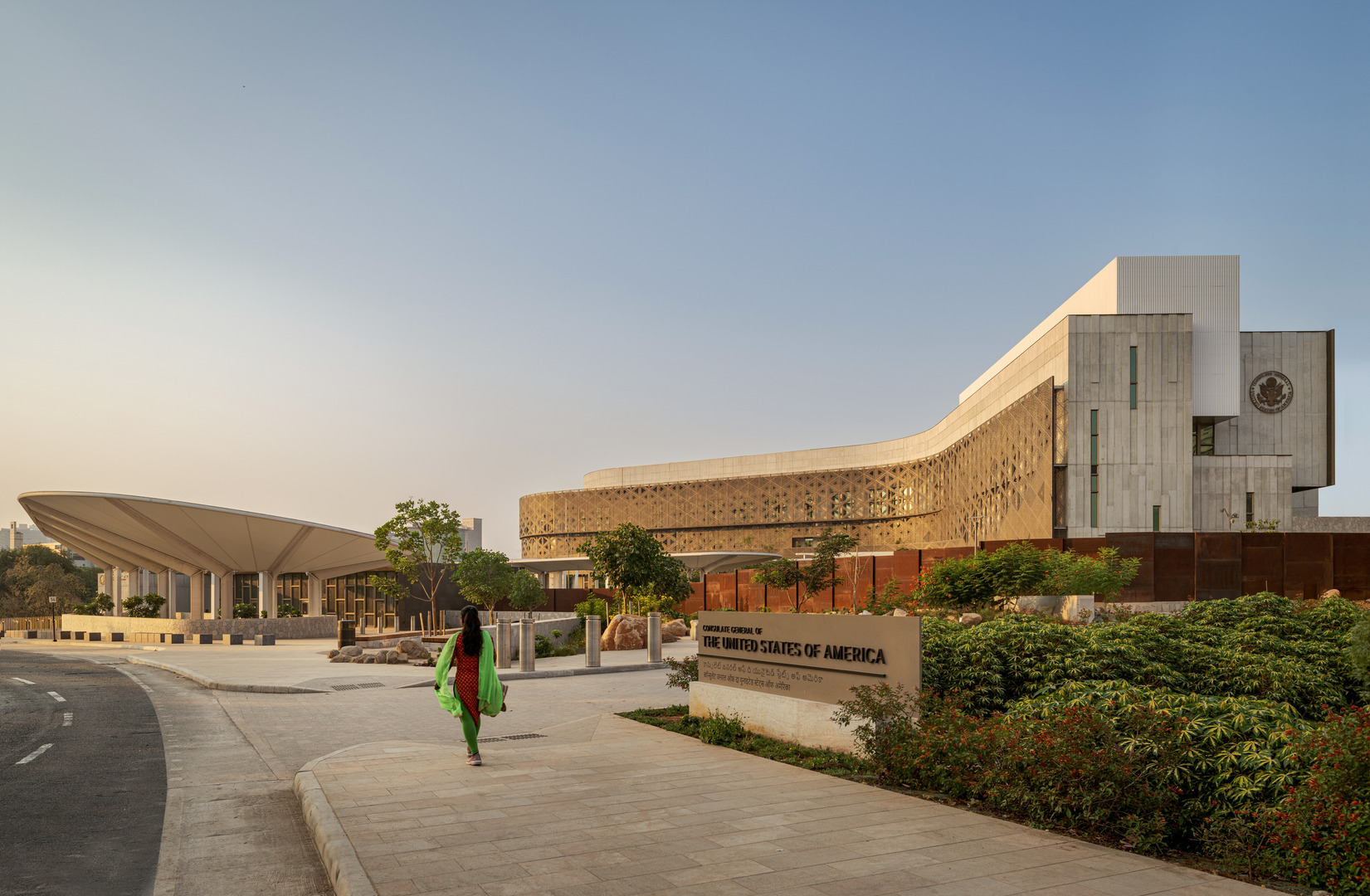
The U.S. Consulate General in Hermosillo is conceived as a careful negotiation between visibility and restraint. As both a diplomatic workplace and a public-facing institution, the project responds to the culture, climate, and neighborhood in which it resides.
Set within a predominantly residential context, the compound addresses the inherent tension between security and openness. The site is bordered on three sides by adjacent homes, requiring a calibrated response to scale, massing, and orientation. Building placement, controlled views, lighting, and acoustics were carefully considered to respect the privacy of neighboring residents while maintaining the operational and security requirements of a modern consulate.
Central to the design is a two-story external armature that wraps the chancery building. Clad in patinated zinc, this open framework contrasts with the restrained base of white precast concrete, establishing a layered architectural identity. The armature reduces the perceived scale of the four-story chancery and organizes the façade into a more legible, human-scaled composition. Perforated infill panels are strategically deployed to filter views—screening adjacent residences while selectively framing the distant city and mountain landscape.
Environmental performance and spatial experience are integrated within this system. Tensioned fabric elements extend across the upper portions of the armature, providing solar control and reducing glare while allowing diffuse daylight into interior workspaces. At ground level, the structure extends outward to form deep shaded canopies at primary entry points, creating sheltered outdoor rooms for arrival, gathering, and public engagement.
Throughout the project, shade is treated as both a climatic necessity and a diplomatic gesture. The resulting architecture is measured and responsive—an environment that supports the daily functions of diplomacy while engaging its context with clarity and respect.
Project facts
Design Architect: Richärd Kennedy Architects
Associate Architect: HGA
Local Architect: Carte Arquitectos
Architect of Record: Page (Page Southerland Page, Inc.)
Client: U.S. Department of State Bureau of Overseas Buildings Operations
Size: 113,785 SF
Project Type: Civic + Public
Services: Architecture, Interior Design
Delivery Method: Design-Build with Bridging Documents
General Contractor: BL Harbert International
Design MEP Engineer: ARUP
Design Structural Engineer: ARUP
Civil Engineer: AST Cowen Design Group
Landscape Design Architect: OLIN
Photographer: Gabe Border
Press & Awards
2023 – Architectural Products, "The Consulate Architect" Volume 21, January/February 2023, p. 28-33
2022 – The Chicago Athenaeum, American Architecture Award in the Government/Civic Buildings Category
2020 – AIA WMR Design Excellence, Merit Award, Unbuilt


.jpg)